

Today, hundreds of students and staff of Kyambogo University gathered for the 5th Kyambogo University Counselling Open Day in CTF 105. Under the powerful theme, “From Survival to Thriving: Building Emotional Health University Communities,” the event served as a clarion call to move beyond the “bare minimum” of academic endurance and toward holistic personal wellness.
The day kicked off with high energy, featuring a vibrant march through the university precincts followed by a pulse-pounding aerobics session reminding everyone that a healthy mind begins with a healthy body.
The Dean of Students, Mrs. Bridget Mugume, set a profound tone for the day. She noted that for too long, the university experience has been reduced to “mere survival” the frantic race to pass exams and get by. “Today is a call to action,” Mrs. Mugume stated. “We are turning our focus from surviving to thriving. Resilience is not just a popular term; it is a real experience that requires us to prioritize mental health as much as our academics.”
The Principal Counselling Psychologist echoed these sentiments, emphasizing that the Open Day provides a vital platform to showcase the professional services available at the Guidance and Counselling Unit. The event specifically addresses the unique pressures young adults face today, from relationship complexities and addiction to the heavy weight of academic demands.
The University Secretary, Mr. Arthur Katongole, delivered a masterclass on the “cost of silence.” He delved into the hidden stressors that plague even the highest-performing students and staff.
Central to his address was the concept of Emotional Intelligence (EI). Mr. Katongole challenged the audience to identify their emotional “triggers” be they specific people, places, or words. High EI leads to motivation, focus, and autonomy. These individuals are not just more successful in their careers; they are happier and healthier. Whereas, Low EI often manifests as loneliness, resentment, and chronic frustration, which can lead to physical illness.
“Self-awareness is our greatest tool,” Katongole noted, citing Goleman’s competencies. “Knowing how we feel in the moment allows us to drive better decision-making and build a strong sense of self-confidence.”
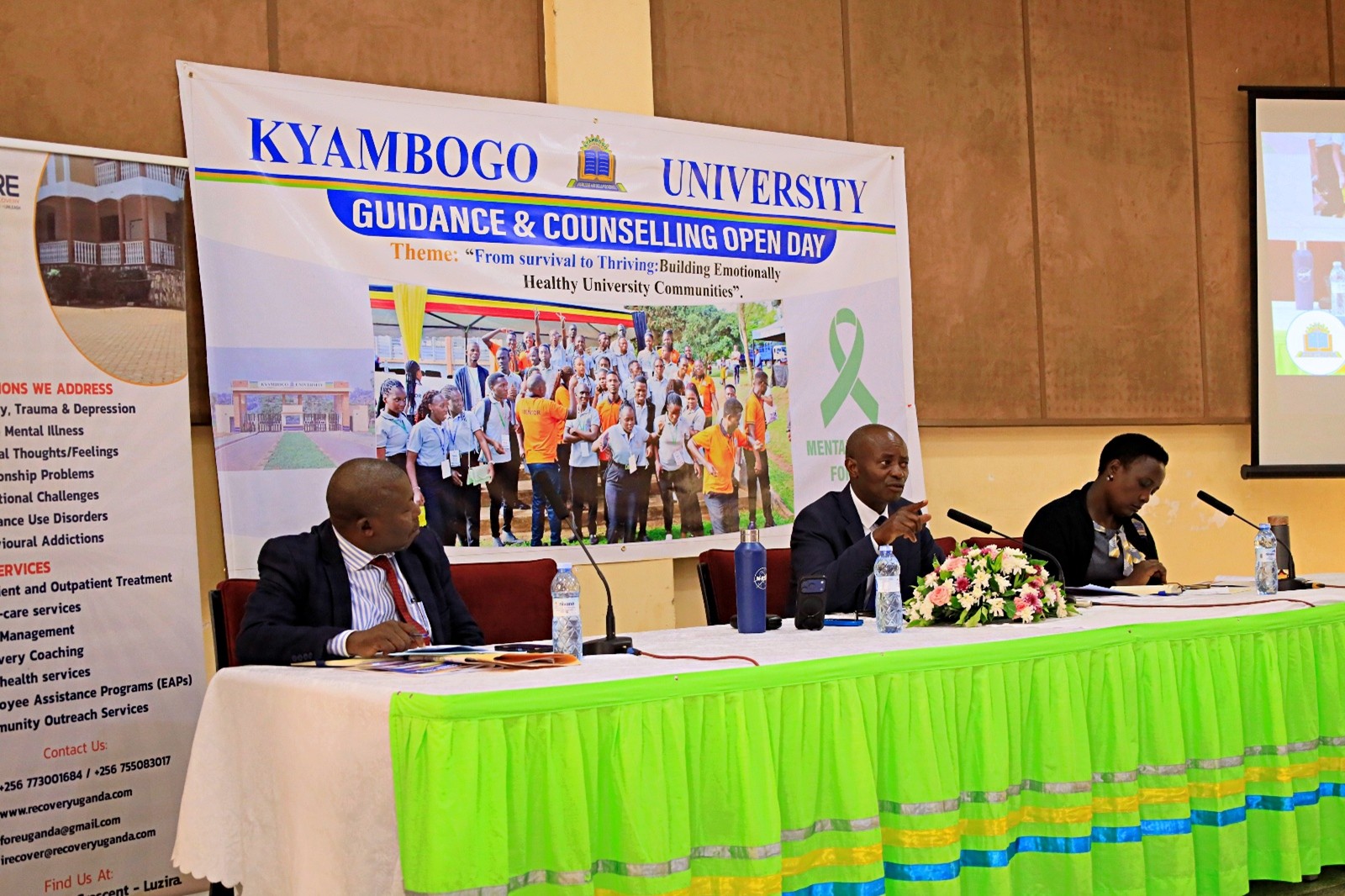
The student voice was brought to the fore by Osiga Silver, Minister for Academics and Professional Affairs (representing H.E. Andama Emmanuel). He highlighted the challenges facing students: food security, tuition, missing marks, relationships, peer pressure, adjustment issues, grades, substance abuse, and self-esteem. “Creating an emotionally healthy community isn’t just the job of the counselors; it’s a shared responsibility,” Silver remarked.
The Deputy Vice Chancellor in charge of Finance and Administration, Assoc. Prof. Justus Kwetegyeka, delivered a compelling address during the Open Counselling Day, emphasizing that academic success is inseparable from mental and spiritual health. In his remarks, Prof. Kwetegyeka highlighted several key pillars for student success: He noted that a major crisis in modern society is that “people lack people to listen to them.” He encouraged the university community to bridge this gap by fostering an environment of empathy. He urged the Counsellors to engage in special sessions with staff members to build professional and personal trust, acknowledging that university life is fraught with challenges, he advised students to deeply understand the institution’s dynamics and develop healthy survival mechanisms. “Whatever you do has consequences,” he cautioned, reminding students of the importance of personal responsibility.
To make mental health services more accessible, Prof. Kwetegyeka encouraged the use of online counselling sessions, noting they are a “cheaper” and more efficient way for students and staff to seek help. the psychological, he advised the student body not to neglect their spiritual lives, citing it as a crucial component of a well-rounded individual. He concluded by extending his gratitude to the university’s partners and the Counselling Unit for their tireless work in supporting the student body’s welfare.

The conversation extended to the workforce, with Chief Human Resources Officer, Richard Keuber Manano, discussing how mental health directly impacts staff performance. He highlighted factors like workload, role clarity, and work-life balance as critical pillars of institutional success. “Good mental health doesn’t mean being happy all the time,” Manano clarified. “It means having the ability to navigate the ups and downs of life in a healthy manner.”
The Open Day wasn’t just about talk; it was about tangible support. Throughout the day, attendees participated in: Free professional counselling sessions, HIV/AIDS testing and voluntary blood donation, Personal testimonies that broke the stigma of “suffering in silence”, and Mental health awareness talks.

As the event concluded, several key strategies were offered for the Kyambogo community to maintain this momentum:
- Seek Institutional Support: Utilize the systems and staff designed to help you.
- Build Peer Networks: Surround yourself with friends who have a positive mindset.
- Adopt Adaptive Mechanisms: Read widely and listen to success stories to find what works for you.
- Avoid Isolation: Learn the art of socializing and finding joy in community.
- Spiritual Grounding: A final note reminded attendees that in all struggles, faith remains a cornerstone for many in finding ultimate solutions.
Tags: Campus Wellness, Counselling Open Day, Emotional Intelligence, Guidance and Counselling, higher education Uganda, Kyambogo University, Mental Health Awareness, student support, Student Wellness, University Counselling Services