
The success stories of the Kasese and Mbale farmers were captured during a series of interactive field engagements and training sessions led by the Resilient Urban Food Systems (RUFS) project. During these sessions, the farmers shared their transformative journeys with Ms. Jennifer Sibbo, the Senior Public Relations Officer at Kyambogo University, who serves as the Communications Lead for the AgriFose2030 Uganda Hub.
VOICES OF RESILIENCE
The Transformation of Eunice Mutoro Sunday
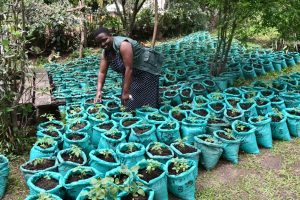 For many, retirement is a time to slow down. But for Eunice Mutoro Sunday, a retired headteacher in Kilembe Division, Kasese Municipality, it was the beginning of a second calling. Today, she is not just an urban farmer; she is a champion of nutrition, a digital entrepreneur, and a leader of women.
Eunice’s journey began decades ago when she witnessed the devastating effects of malnutrition in her community. Despite, sponsored programs highlighting that stunted growth in children was linked to a lack of macronutrients from vegetables, many parents were slow to adopt school gardening initiatives. “I asked myself, ‘What can I do that these people have failed to do?'” Eunice recalls. “I decided to practice what they taught us.”
What started as a small experimental plot of ten potted gardens soon blossomed into SUNICE Urban Farm. Guided by the Resilient Urban Food Systems (RUFS) project and lead experts like Professor Frank Mugagga, Eunice transitioned from subsistence to commercial farming. Through the RUFS project, Eunice mastered:
- Organic Practices: Using manure from her pigs and poultry to replace expensive, harsh chemicals.
- Digital Marketing: By sharing photos of her produce on social media, she expanded her reach far beyond Kilembe.
- Her digital presence secured her a lucrative tender with Serengeti Energies, supplying fresh vegetable seedlings to women in the mountain regions.
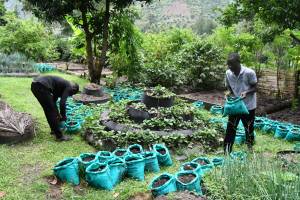
As a Mothers’ Union Coordinator in the South Rwenzori Diocese, Eunice has turned her farm into a classroom. She has institutionalized a “Healthy Competition” among women, where they visit each other’s homes to inspect kitchen gardens, cooking stoves, and sanitation.
The impact is visible in the faces of the children in her community. “The children are no longer looking malnourished,” she says proudly. By encouraging pregnant mothers to prioritize nutrition in the first 1,000 days of a child’s life, she is systematically fighting the stunting she first saw as a young teacher.
“As an individual, this farming has really helped me because it keeps me busy, and I get income. This has helped me educate my children and sustain my family. I have gotten many friends and increased my social network. I have gotten more knowledge as I interact with different people, for example, professors, and I have also been exposed as I move to different districts.” Eunice rejoices
“As for RUFS, they have helped me a lot, through technical advice and helping me to document my work. Currently, I am writing a book. Through documenting my work and writing online, I can get more market. I encourage everyone to start urban farming. You can begin small, don’t fear, and keep positive.” Eunice narrates
From Hospitality to Harvest: The Agribusiness Evolution of Wepukhulu Juma
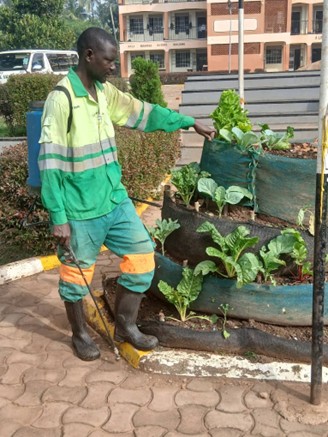 For over a decade, Wepukhulu Juma climbed the ladder of the hospitality industry in Mbale District. But after eleven years as a hotel manager, he realized that true stability required a different kind of growth, one that started with gardening. Inspired by a simple newspaper story about a kitchen garden, Juma traded his suit for a business mindset in urban farming, proving that agriculture is the ultimate “five-star” venture.
Juma’s transition wasn’t just about changing jobs; it was about changing perceptions. In a community where farming is often seen as a “last resort” for the unemployed, Juma set out to prove it was a high-value profession. He established a model farm to show neighbors that small-scale urban plots could be highly profitable. By focusing on “quick-win” vegetables like green peppers, bilinganya (eggplant), and leafy greens, he ensured a consistent daily income. Leveraging his background in hospitality, he bypassed middle-men and secured direct supply contracts with local schools and major hotels, the very industry he once managed.
The success of Juma’s urban farm provided more than just financial independence; it provided a platform for leadership. “By treating the soil with passion and a business mindset, urban farming has not only sustained my family but built a legacy of resilience.”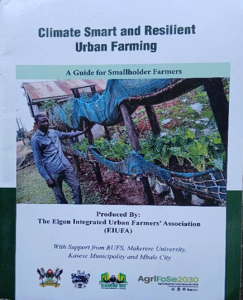
Through his involvement with the Resilient Urban Food Systems (RUFS) project, Juma achieved a milestone few small-scale farmers reach: becoming a published author. His book, Resilient Food Urban System, now serves as a technical guide for the next generation of “agri-preneurs.”
“Since publishing the book entitled “Climate Smart and Resilient Urban Farming” my professional reach has expanded beyond my expectations. As a non-agriculturist, I once found it difficult to win large-scale contracts; now, my book serves as my strongest credential. It has ‘sparked’ opportunities across schools, hotels, and religious institutions, and paved the way for me to lead impactful comunity trainings in Mbale, Kasese, and for various international organizations.” Juma says
Teddy Nyamusiba’s Journey from Garden to Greatness
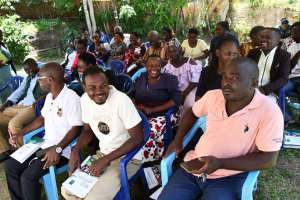 In Kilembe Central Division, Teddy Nyamusiba is living proof that you don’t need a massive plantation to build a multi-million-shilling enterprise. Once a subsistence farmer with limited technical know-how, Teddy’s partnership with the Resilient Urban Food Systems (RUFS) project transformed her small home plot into a powerhouse of diversified agribusiness.
Teddy’s transformation was rooted in a fundamental shift in perspective. Rather than attempting to cultivate her entire land at once, she followed a strategic “incremental growth” model; She started with a small, manageable space to master her craft before scaling, when pests threatened her first crop, RUFS experts provided the technical expertise needed for effective pest management and high-quality tomato cultivation. Teddy moved away from “guesswork” and began recording every expense and sale with precision.
By investing just a few hundred thousand shillings in high-quality tomato varieties and proper care, Teddy realized a return that far exceeded her expectations. “I evaluated what I had invested and that became millions. At the end, I had sold tomatoes worth twenty-five million shillings.” Teddy didn’t stop at tomatoes. She used her profits to build a resilient, multi-stream business empire, reinvested into piggery and poultry venture, established fruit orchards growing mangoes, oranges, and lemons and she has used the profits to purchase a maize-grinding machine to process her own and the community’s produce.
Today, Teddy is no longer just a farmer; she is a district-level success story and a mentor to others. Her journey from a simple home garden to a diversified commercial empire serves as a roadmap for any urban farmer. Her message is simple: Listen, learn, and apply. By combining a willingness to be taught with a relentless work ethic, Teddy Nyamusiba has proven that a small plot of land is more than enough to grow a flourishing business.
The Professional Perspective: Resilience through RUFS
Behind the individual triumphs of farmers like Eunice, Juma, and Teddy lies a robust academic and technical framework. The Resilient Urban Food Systems (RUFS) project, led by Professor Frank Mugagga of Makerere University, represents a shift from traditional aid to sustainable, integrated empowerment.
- The Pillar of Integrated Training
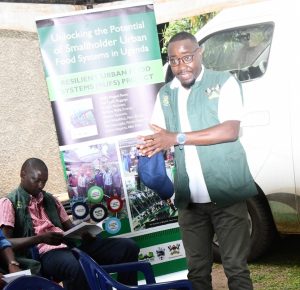 According to Professor Frank Mugagga, the success of the current phase (2024–2026) is built on Integrated Farmers’ Training. This approach acknowledges that a successful farmer must be more than a cultivator; they must be a business manager and a communicator.
The project institutionalized bookkeeping, moving farmers from subsistence to business. By tracking financial, input, and sales records, farmers gain the data necessary to secure loans and scale operations.
RUFS has empowered farmers to find their “voice” through writing and public platforms like TV and radio. This ensures that the knowledge doesn’t stay on one farm but reaches the masses.
Recognizing that group dynamics are the engine of sustainability, the project has helped farmers in regions like Kasese restructure their leadership and create peer-learning action plans.
- Sustainability & Self-Reliance
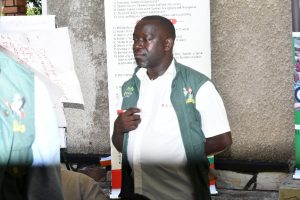 Henry Stanley Mbowa, lead facilitator from Aid Environment, emphasizes that the technical backbone of RUFS is low-cost, high-impact organic innovation. This strategy addresses the two biggest hurdles for urban farmers: pest management and high input costs.
Henry emphasizes utilizing locally available materials such as hot pepper, fermented urine, and Tithonia to repel pests without the environmental or financial burden of chemicals. He also advises scaling the use of urine-based fertilizers and dung manure to amplify yields while conserving the environment. The project follows a “learn-by-doing” philosophy. As Henry notes, “Knowledge learned when implemented cannot be forgotten.”
- Research & Future-Proofing
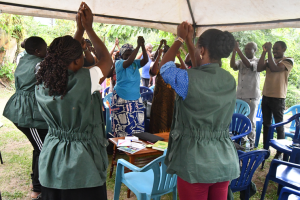 A unique element of the RUFS project is the integration of academic research with community action. Through the Group Level Assessment (GLA) method, researchers and farmers interact in an engaging, non-hierarchical environment. This participatory process has allowed the team to assess Social and Hydrological Histories understanding how communities have been affected by environmental shocks and, more importantly, how they have “bounced back.”
“If we leave the system in place, it will be good for us. The goal is to ensure farmers have a bigger voice than they had before.” Professor Frank Mugagga, Makerere University
 According to Dr. Judith Nagasha, a Senior Lecturer at Kyambogo University who is the AgriFose2030 Uganda Hub leader, the RUFS project has demonstrated that resilience begins with knowledge, grows through community action, and flourishes through innovation. Across Kasese and Mbale, farmers have transformed small urban spaces into engines of nutrition, income, and dignity. “This story reminds us that sustainable food systems are built when people are empowered to learn, lead, and inspire others.” Judith says
The farmers stories and the success of the RUFS project proves that urban farming is more than just growing food; it is about dignity, health, and financial independence. As Eunice, now an author-in-the-making, puts it: “You can begin small, don’t fear, and keep positive.” Through the integration of traditional wisdom and modern technology, the farmers of Kasese and beyond are planting the seeds of a resilient future.