
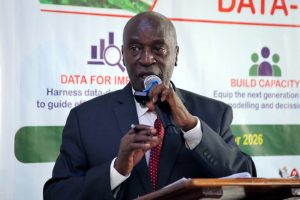
The Vice Chancellor of Kyambogo University, Prof. Eli Katunguka-Rwakishaya, said universities struggle to translate research into policy because politicians focus on re-election rather than research-driven policy formulation. This has made it difficult for academic research to translate into policy. He urged universities to collaborate to solve a common problem: “Our problems will be solved by working together.” Prof. Katunguka added that all universities have something to teach and learn from each other. He said that if universities strengthen collaboration, they can expand their services and improve people’s well-being by building the next generation of actors, namely young researchers, growing the number of PhDs, designing studies, and making recommendations that transform society. He appreciated the efforts and research in malaria control, given that malaria is a major problem and has severely affected women and children.
He urged researchers and university leaders to build capacity within universities by supporting the best lecturers, supporting students to produce the best research, and improving communication skills, presentation skills, and other soft skills.
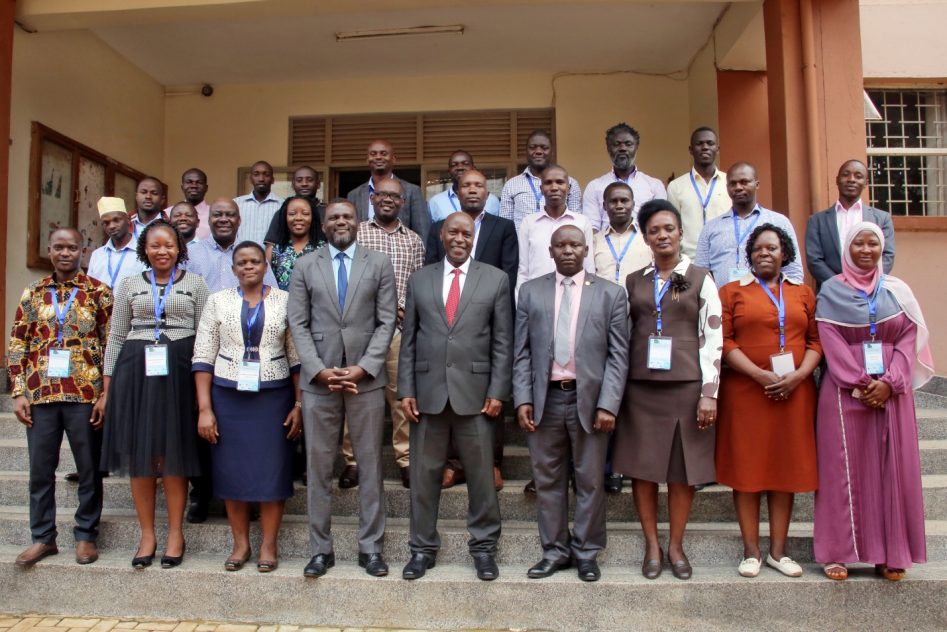
The Vice Chancellor was speaking at the Malaria Workshop, which brought together researchers and students from Kyambogo University (the host), Busitema University, Makerere University, Mbarara University of Science and Technology, and the London Mathematical Society. The workshop theme was: Shaping Uganda’s malaria future with data-driven models: Inspiring next-generation control actors.
On his part, the Dean of the Faculty of Science, Assoc. Prof. Edirisa Mugampoza, said that statistical data and computational modelling are important for shaping malaria control and prevention in Uganda. At the same event, the Head of the Department of Mathematics and Statistics at Kyambogo University, Dr Mbabazi Doreen, said that mathematical models are critical to understanding malaria control. She hoped the findings from this research would help inform policy and develop practical strategies to prevent malaria in Uganda.