
Kyambogo University is seeking to strengthen its digital transformation, research visibility and innovation capacity through enhanced collaboration with the Research and Education Network for Uganda (RENU).
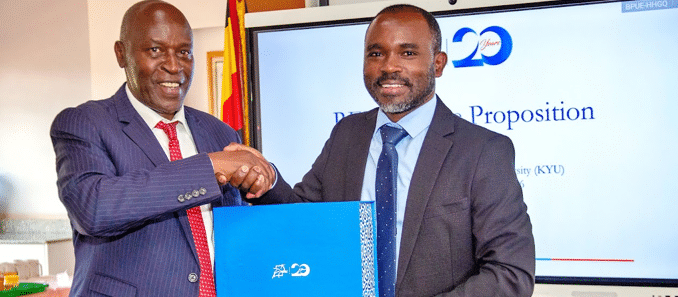
This was highlighted during an engagement between the University’s top management, led by the Vice Chancellor, Prof. Eli Katunguka-Rwakishaya, and a delegation from RENU led by its Chief Executive Officer, Mr. Nicholas Mbonimpa. The meeting discussed the partnership, ongoing support, and opportunities for further collaboration.
During the engagement, Mr. Mbonimpa emphasised that RENU’s mandate extends beyond providing internet connectivity to strengthening the quality of education, research, innovation and technological development across Uganda’s higher education institutions.
RENU a non-profit organisation owned by universities, currently connects approximately 1,300 sites including schools and universities with plans to expand connectivity and digital services to more educational institutions in partnership with the Ministry of Education and Sports and the Uganda Communications Commission.
One of the key issues discussed was the need to improve the visibility and global recognition of Kyambogo University’s research outputs. Mbonimpa observed that although the University undertakes significant research and innovation some of its achievements do not receive the recognition, they deserve because of gaps in research visibility infrastructure and the adoption of essential digital tools. He highlighted services such as ORCID, DataCite and Crossref which support researcher identification, research data management and the identification and referencing of scholarly publications. These services together with properly developed institutional repositories can help make the University’s research outputs more discoverable and accessible to the international academic community.

RENU Team and Kyambogo University members of Top Management pose for a group photo
RENU also presented a proposed research information dashboard that would consolidate information from different research databases into a single platform. The system is intended to provide university management with a comprehensive view of research teams, funding sources, ongoing projects and research outputs, supporting informed institutional planning and decision-making.
The engagement also explored opportunities to improve access to premium academic journals and other digital learning resources for students and staff. Through its collaboration with the Consortium of Uganda University Libraries, RENU is facilitating access to digital academic resources using institutional email accounts. This initiative would enable members of the university community to access scholarly resources beyond the traditional restrictions of physical campus networks.
Mbonimpa explained that the integration uses the same authentication infrastructure as eduroam and could be implemented once the University’s ICT team engages with RENU. He emphasised that the service would be provided at no additional cost to the University, presenting an opportunity to strengthen teaching, learning and research through improved access to academic information.
Artificial intelligence and the infrastructure required to support its development also featured prominently in the discussions. Mbonimpa explained that developing and operating advanced artificial intelligence models requires substantial computing infrastructure, which individual universities may find difficult to acquire independently. He noted that RENU is working to address this challenge through collective investment in shared infrastructure that universities can access to develop and support their own AI solutions.
The CEO further revealed plans to deploy 5G research infrastructure at Makerere University and Kyambogo University, providing students in telecommunications and computer science with opportunities to access and experiment with emerging technologies.
The University was also recognised for its significant use of RENU’s eduroam service. According to Mbonimpa, Kyambogo University became the heaviest user of eduroam in the country in the previous year and has one of the largest eduroam coverage areas. He noted that RENU provides free Wi-Fi in the University’s student hostels, extending connectivity to approximately 25,000 students across campus.
In his remarks, the Vice Chancellor, Prof. Eli Katunguka-Rwakishaya emphasised the importance of ensuring that university research, innovation and capacity-building initiatives translate into measurable outcomes. He challenged universities to move beyond counting activities and investments and instead demonstrate the tangible results of their work. The Vice Chancellor stressed that universities must remain relevant to society by developing innovations that address real challenges and deliver practical benefits to the public.
He cautioned that public universities risk losing public confidence if they fail to demonstrate their value and provide quality education and meaningful solutions to societal challenges. He further underscored the importance of accountability, institutional commitment and making effective use of available resources and partnerships.
The discussions also addressed the need to strengthen coordination between the University and RENU including formalising the working relationship through an institutional agreement and improving communication about the services and support available to the University.

Partnership presentation
Dr. John Okunzi, Director of ICT Services at Kyambogo University, highlighted the University’s progress in artificial intelligence, including the deployment of a locally developed Large Language Model (LLM). He emphasised the importance of embracing emerging technologies to strengthen teaching, learning, research and institutional operations.
The engagement concluded with a shared commitment to strengthening collaboration, improving the implementation of available digital services and making RENU’s contributions to Kyambogo University more visible.
For Kyambogo University, the engagement presents an opportunity to leverage its partnership with RENU to enhance research visibility, expand access to academic resources, strengthen digital infrastructure and prepare students and researchers for emerging technological developments.