

Kyambogo University has signed a Memorandum of Understanding (MoU) with the Luigi Giussani Foundation (LGF) establishing a framework for collaboration aimed at strengthening teacher education and contributing to the transformation of secondary education in Uganda. This Partnership under the Mastercard Foundation-funded Leaders in Teaching Uganda Programme seeks to strengthen teacher preparation, expand digital learning, promote STEM education and advance inclusive teaching.
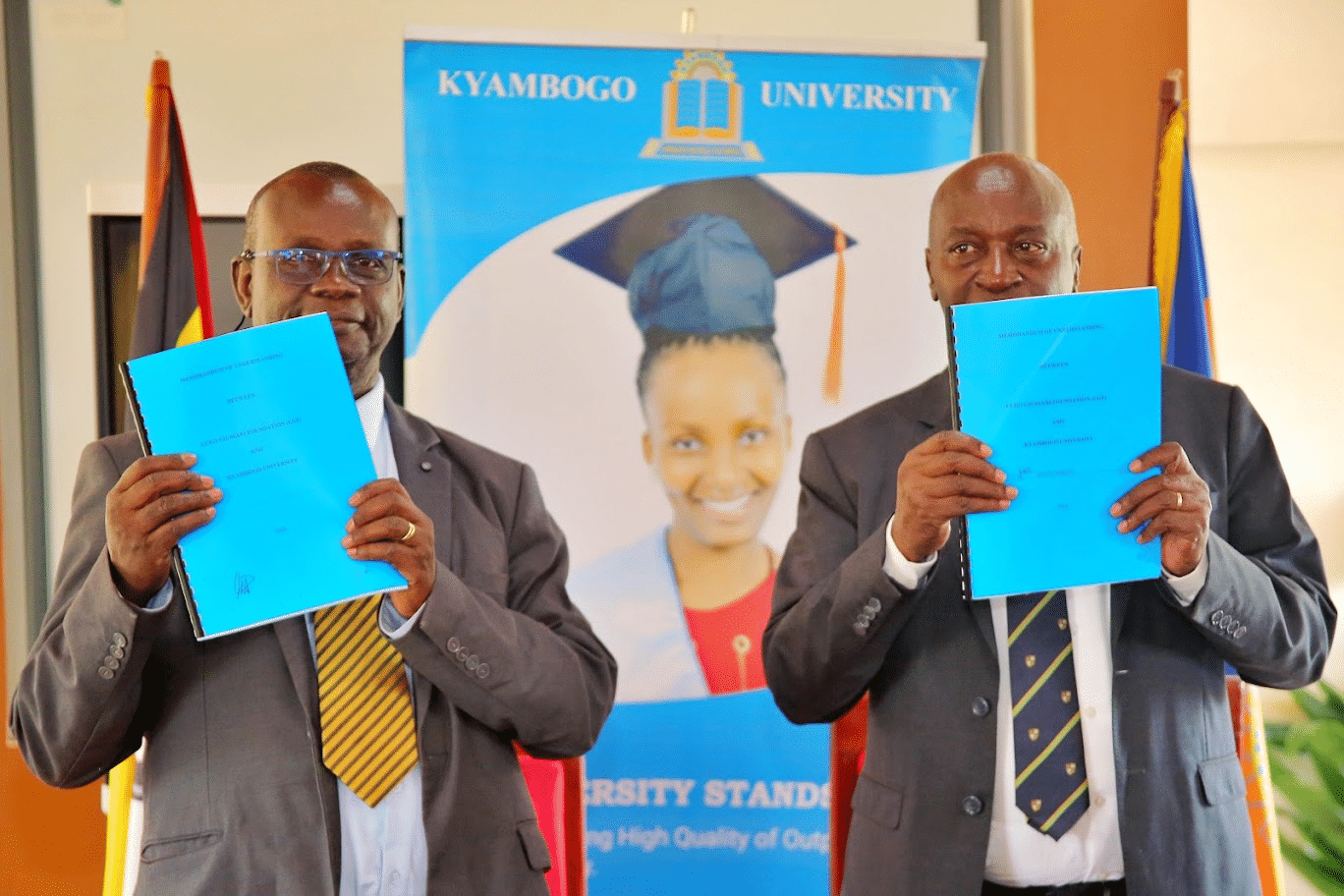
The agreement was signed by the Vice Chancellor of Kyambogo University, Professor Eli Katunguka-Rwakishaya and Professor George William Pariyo representing the Luigi Giussani Foundation during an engagement held in the University’s Council Room. The signing brings together two institutions with a shared interest in improving the quality of education, strengthening teacher preparation and expanding opportunities for professional development under the Mastercard Foundation-funded Leaders in Teaching (LiT) Uganda Programme.

The delegation from Luigi Giussani Foundation and Kyambogo University take a group photo after signing
The meeting was attended by members of Kyambogo University’s top management and representatives of the Luigi Giussani Foundation, including Mr. Emmanuel Adengo and Ms. Gillian Atuheire alongside other members of the visiting delegation.
The engagement commenced with welcome remarks by Professor Katunguka-Rwakishaya, followed by introductions of participants from both institutions.
The Deputy Vice Chancellor, Finance and Administration, Associate Professor Justus Kwetegyeka subsequently presented an overview of Kyambogo University highlighting its institutional history, academic strengths, national contribution and longstanding commitment to teacher education. He traced the University’s establishment to the merger of three institutions, bringing together complementary expertise in teacher training, technical education and vocational education. He emphasised Kyambogo’s historical contribution to preparing teachers for Uganda’s education system, particularly in Science, Technology, Engineering and Mathematics (STEM).
The presentation also highlighted the University’s distinctive contribution to inclusive education through its Faculty of Special Needs and Rehabilitation, which supports the preparation of professionals and the advancement of educational opportunities for persons with disabilities. With a student population of approximately 33,000 including learners in affiliated institutions, Kyambogo University continues to serve students from different parts of the country. Its regional reach and experience in teacher preparation place it in a strategic position to contribute to national education development initiatives. The Deputy Vice Chancellor also highlighted the University’s commitment to strengthening partnerships that advance academic excellence, innovation and inclusive development.

Representatives of the Luigi Giussani Foundation and the programme consortium then presented an overview of the Mastercard Foundation-funded Leaders in Teaching Uganda Programme, outlining its objectives, implementation arrangements, key interventions and potential areas of collaboration with Kyambogo University.
The Leaders in Teaching Programme is a five-year initiative running from 2025 to 2030, implemented under the strategic leadership and oversight of the Ministry of Education and Sports. The Luigi Giussani Foundation serves as consortium lead working alongside UNICEF and other education sector partners.
The initiative seeks to address persistent challenges within Uganda’s secondary education system, including shortages of qualified teachers, limited opportunities for continuous professional development, inadequate integration of technology into teaching, low teacher motivation and gaps in school leadership.
The programme adopts a comprehensive approach structured around four interconnected pillars: Recruit, Train, Lead and Motivate covering the different stages of a teacher’s professional journey.
The Recruit pillar focuses on attracting qualified individuals into the teaching profession with particular attention to addressing teacher shortages and increasing the participation of women in STEM education.
The Train pillar seeks to strengthen pre-service and in-service teacher education through improved pedagogical approaches, competency-based curriculum delivery, digital literacy, practical teaching experience and professional development.
The Lead pillar focuses on improving school leadership and management by equipping school leaders with the skills to establish supportive teaching and learning environments.
The Motivate pillar seeks to strengthen teachers’ professional growth, recognition, mentorship and motivation with the broader objective of improving teacher satisfaction and retention. Through these interventions, the programme targets 2,091 secondary schools, 67,000 in-service teachers, 7,500 pre-service teachers, 300 university tutors and 6,273 school leaders across Uganda.
A significant component of the programme is its scholarship initiative targeting 1,000 young women pursuing STEM-related teacher education. The initiative is designed to increase women’s participation in the teaching profession, particularly in science, technology, engineering and mathematics while addressing gender disparities in the education workforce.

The scholarship package provides support for tuition and functional fees, accommodation and laptops to facilitate academic and digital learning. The programme also incorporates deliberate inclusion measures with 5 per cent of the scholarship opportunities reserved for persons with disabilities and 7 per cent for refugees and individuals from marginalised communities.
For Kyambogo University which has a longstanding contribution to teacher preparation the initiative presents an opportunity to strengthen the pipeline of future STEM educators and promote greater participation of women in science-related teaching careers. The presentation further highlighted interventions aimed at strengthening the capacity of universities and teacher training institutions to respond to the changing demands of education.
These include ICT integration in university teaching and learning, the development of digital learning materials, establishment of Learning Management Systems (LMS), provision of digital infrastructure and training of academic staff. Other interventions focus on strengthening pre-service teacher education, improving teaching practice in secondary schools, career guidance and counselling and equipping future teachers with life and employability skills.
Disability inclusion, monitoring, evaluation and learning were highlighted as important cross-cutting areas to ensure that programme interventions remain accessible, responsive and effective.
Following the presentations and deliberations, the two institutions proceeded to the formal signing of the Memorandum of Understanding.
Professor Eli Katunguka-Rwakishaya signed on behalf of Kyambogo University, while Professor George William Pariyo signed on behalf of the Luigi Giussani Foundation.
The Vice Chancellor delivered the closing remarks, appreciating the visiting delegation and highlighting the importance of institutional partnerships in advancing the University’s academic mission and contribution to national development.