
Mr. Timothy Musoke Ssejjoba, the Commissioner for University Education and Training at the Ministry of Education and Sports, has said that higher education institutions must maintain strong foundations in literacy, numeracy, science and disciplinary knowledge while creating opportunities for learners to investigate, practise, design, explain and reflect. “Competence grows when understanding is put to work,” Ssejjoba said, emphasising the need to bridge the gap between academic knowledge and its practical application. He made the remarks while officiating as Guest of Honour at the opening of the 4th East African Teacher Education Symposium, organised by the Faculty of Arts and Humanities at Kyambogo University from November 4–6, 2026.
Ssejjoba challenged universities to align their academic programmes with Uganda’s national development priorities, particularly agro-industrialisation, tourism, mineral development, and science, technology and innovation. He explained that agro-industrialisation requires graduates capable of applying scientific knowledge to production, reducing post-harvest losses, processing agricultural products and meeting market standards. In tourism, he said, institutions must produce graduates with effective communication skills, professional service standards, digital capabilities and an understanding of the country’s cultural and natural heritage. He further emphasised the importance of technical competence, occupational safety, environmental responsibility and the ability to maintain and improve production systems in the minerals and industrial sectors. On science, technology and innovation, Ssejjoba called for the development of curious and creative minds capable of investigating societal problems, developing solutions and transforming ideas into useful products and services. He noted that, beyond technical and professional competencies, employers and communities need graduates who are dependable, ethical, adaptable and capable of working collaboratively. “The future engineer, farmer, entrepreneur, scientist, health worker and public leader all depend on the foundations teachers help them build,” he observed. He challenged symposium organisers and participants to ensure that their deliberations produce practical recommendations that educational institutions and policymakers can translate into action.
Speaking at the same event, Kyambogo University Vice Chancellor, Prof. Eli Katunguka-Rwakishaya, observed that the education sector continues to grapple with the effective implementation of Competence-Based Education and Training (CBET), an approach intended to equip learners with competencies to address societal needs. He identified inadequate funding, limited infrastructure, large class sizes and the attitudes of education implementers as some of the challenges requiring attention if the approach is to achieve its intended objectives. Prof. Katunguka-Rwakishaya emphasised the need to address these implementation challenges to ensure that competence-based education moves beyond policy intentions and becomes an effective approach to teaching and learning. The three-day symposium brings together education stakeholders to deliberate on teacher education and the evolving demands of education systems in East Africa.
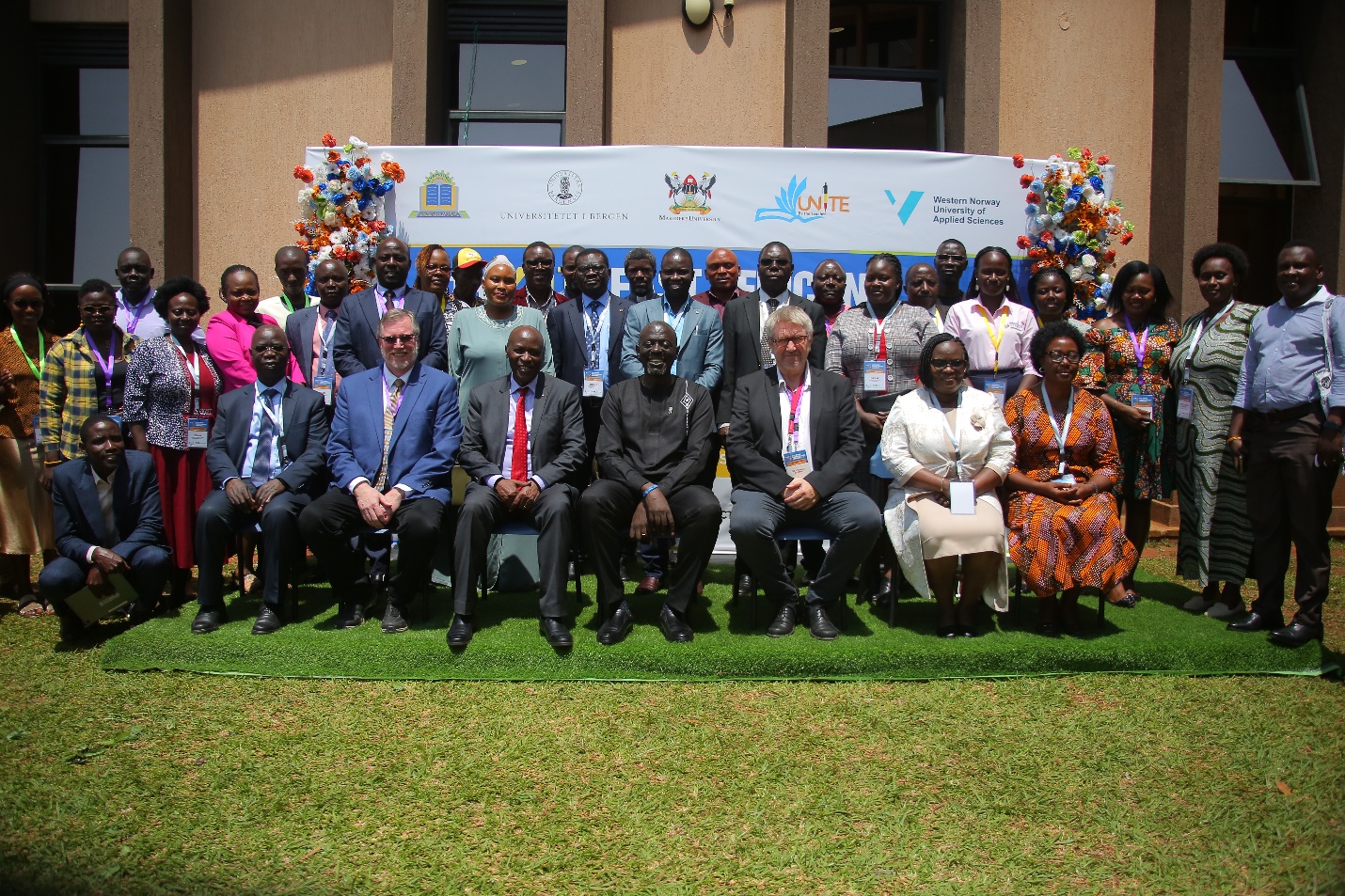
Some of the participants pose for a group photo after the workshop